|
|
|
CHAPTER 7
FAQ - Updated July 2026
FAQ - Frequently Asked Questions
The Cosmos Reconsidered is a website and book that attempts to answer all cosmological questions correctly with absolutely known, proven, and commonly used elsewhere classic physical physics based science. The true physics that has been beat on and hammered out over thousands of years... This chapter is especially aimed at answering some of the so far unanswered mysteries of the cosmos. Easily understood physics that has previously been totally unknown, totally misunderstood, and on up to being complete fairy tales. But in fact all of them tied directly to everything else.., through the EM field of gravity. Be sure to check back as we will continue to add explanations as I find the time.
Henceforth, as of Sept 2026, we will be adding new entries here at the top, to eliminate searching through the rest if you've already seen them. We will also move updates to existing answers to the top as they may occur.
[YOUNG'S TWIN SLIT EXPEDRIMENT.
[QUESTION] How does it produce the light and dark bars on the back wall.
[ANSWER] We know from de Broglie that electrons are what deliver light. It is his ‘pilot wave’ that is blue shifted into the EM spectrum of light. This has been validated in many was. First that we know photons do not exist. One of their many falsifications is that each are described as being a single frequency. Which means they are ‘sine’ waves.., and it it well known that ‘sine’ waves are never found in any spectrum. There is an infinite difference between a ‘sine’ wave and a ‘spectrum’ wave. So photons could not produce light even if they did exist.
Further on the electron delivering light is seen when they fire single electrons at the TSR and they get the same light and dark bars on the back wall as when they think they’re firing photons. They’re really firing electrons. There are no photons.
So now when they monitor a slit in the TSR they place a half mirror in the path to measure the activity there. But of course we know that this kills the interference pattern’s light and dark bars that would otherwise be seen on the back wall. Even though the half mirror would only kill half the amplitude of any light that was coming through it.
So the thinking today is that when we ‘look at a photon’.., it hides. Or something like that. lmao
Here’s what truly happens.
The electron that is delivering its blue shifted pilot wave’s EM spectrum of light hits the half mirror and is embedded into it. It is obstructed by the half mirror and is prevented from delivering it’s EM spectrum to the back wall. That is why there is no interference pattern. Simple classic physics.
So I’ll correct the the non-existing ‘photon’ name in the question by calling it its correct name; electron. This ‘single’ electron fired at the TSR with both slits monitored will be intercepted at either slit so there will be no light reaching the back wall at all.
But now there is some finessing that needs doing. To make certain questions on the whole experiment useless to ask. :) There is the correct idea that a single electron is emitting its EM spectrum well before it reaches either slit. The incorrect version that came from it is that I’ve seen illustrations that show a single electron’s spectrum beginning it’s spread once it passes through the slit it was aimed at, while a part of the spectrum that was already emitted before the electron reached the front wall was passing through the second slit, and beginning it’s own spreading of spectrum wavelengths. Supposedly allowing the light and dark bars to be produced again. But this cannot possibly happen. Because of the differences there are between what has passed through each slit.
When the electron passes through a slit it is immediately spreading it’s entire spectrum of wavelengths outward to cover the entire back wall. As it approaches the back wall the diameter of that spread is continuously contracted to the point it becomes a microscopic speck as the electron hits the back wall. So during the electron’s trip from the front wall to the back wall, the spread of it ‘s spectrum is contracting inward so that every wavelength of it is wiped across every pixel of the back wall… That is what’s needed to create an interference pattern. Every color being everywhere on the back wall to create ‘persistence’ white. While an out of phase version of that contraction from the other slit causes the bars.
But if the opposite slit is only passing the outside’s spectrum it is only allowing a single wavelength through at at any instant. Which is not what can mix with what the first slit needs to produce the white bars. So the illustrations that show ‘single’ electron (or their other name) being fired at the TSR are very incorrect. Even if electrons could be fired ‘singly’, they would only create what amounts to a white dot on the back wall
Now one more little fact.., when the TSR is operating normally, and electrons are passing both slits normally, there is normally a red twinge to the bars on both sides of the back wall. That red twinge is caused by the distance between the two slits. The two slit’s spectra being wiped across the back wall are offset from each other. Neither’s spread can completely reach the other’s far side.., aka the red wavelength.
Now one more fact. Each of those electrons that pass through a slit produce their own spectrum on the back wall as I’ve said. Every electron hits the back wall directly in line with the slit. That turns out to be their brightest bar for that slit. The other bars each side of that one slit, because of the contraction going on, is illuminated for shorter times and amounts. So for instance we can consider the bars that a single slit will produce will amount to amplitude levels of say 1, 2, 3, 2, 1.
So when each of the slits intensities are combined, with their offset separation taken into account, the combined result of the two amplitudes on the back bar turns out to be 1, 2, 3, 4, 3, 2, 1… The two level 2 amplitudes combine at the center. The reason the center bar is always the brightest.
Remember photons are not real. :)
ENTANGLED PARTICLES
[QUESTION] Can they be real..??
[ANSWER] No they are not real. Not even theoretically. Here is what Wicki says they are... A single source of light is sent through a crystal and it is deflected in two or more directions. The two overlapping points will certainly continue to overlap as they continue to spread apart further and further... But one of those points will never be able to be packed up, put on a plane, and taken anywhere...
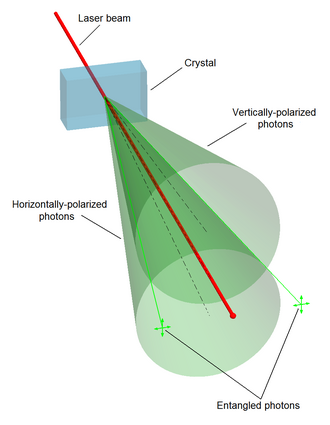
Quatum seems to think they're massless particles, while obviously Wiki is showing us massless light. Please don't confuse massless and mass. Quantum people don't have a clue to what's going on.., anywhere. They even admit it. If you have any idea that mass and massless are synonymous I suggest you pull up a good dictionary. Light is massless. It does not consist of particles. Photons do not exist. Single frequency wave lengths can not pretend to be spectrum waves. I can't believe I actually have to be saying this kind of stuff.
NEUTRINOS
[QUESTION] Are Neutrinos particles?
[ANSWER] No. The are simply the highest and shortest wave lengths we're aware of. Those that require so much energy to reach us that they are only seen coming from our own sun and a few high energy galaxies closest to us. It is the constant lowering of all incoming spectra velocities that lower and cause their blue shifted high ends to be eliminated.
They are even shorter than what we consider cosmic gamma γ rays. These are the wave lengths that penetrate the earth just as the longer x-rays can penetrate our bodies. Those which require a mere 125 kv of energy for a chest x-ray. :)
MATH
[QUESTION] Does Math 'prove' anything.?
[ANSWER] Math was created by man. Which means it is already limited to man's ability to think and comprehend. It can not handle infinity., and doesn't understand relativity... Then we plug in bad posits such as 'time' for it to use in it's calculations. Is there any wonder on why it keeps coming up with all the dumb stuff..? Like telling us there are multiple universes, instead of multiple 'visible' universes. Each one contained within the one and only infinite cosmos we all know and love. Each one occupied by alien cosmologists who are trying 'in slightly different ways' to figure out what's going on out there too.
Math only tells us what we tell it to say... We make up symbols to represent what we think we know. Then keep plugging them in until it comes up with some ridiculous answer that resonates with the people doing the plugging.
So then they say non-intuitive is an ok way to go... That the cosmos isn't required to make sense. What..? lmao... Of course it is. That's what real science is supposed to be doing. Experimentation, falsification, real physics. Not some dumb ass idea that math is intelligent. It was made to measure and plot what we see here in our particular 'at rest'.., not to *prove* anything.
I often wonder about how these people are supposed to be understanding what they say is not understandable.. Me thinks there just are not enough asylums in the world to hold them.. They're still out there walking the streets.
CMBR
[QUESTION] What is CMBR.?
[ANSWER] CMBR is a cosmic sized version of the TSE.
In the toy version of the twin slit here on earth, there are two sources of rather intense light that mix with each other on the way to the back wall. They create the light and dark bars on that wall.., and if you were to put an antenna to convert that interference pattern into sound you would hear a raspy buzz.
On the larger scale, with the earth being the back wall, and all the galaxies being the light sources that come to earth the equivalent to many many slits sending light waves to earth, the back wall. They all form a much more complex interference pattern that we can hear with our phone wires and other 'antennas'.
Because there are so many sources of very weak light we hear a softer smoother hiss that we call white noise.
And CMBR. :/
It is in fact cosmic radiation, but it certainly is just a natural phenomenon and not from any never happened Big Bang.
DARK MATTER
[QUESTION] What is Dark Matter
[ANSWER] Every star in every galaxy is tearing apart their atoms with their ongoing nuclear explosions... They spew out all the bits..; electrons, protons, neutrons, and more, as what we call solar wind from our own sun.
They're sent out in all directions from our sun. Those that reach earth take an average of three days to get to us and at times they give us trouble with our communications. But what happens to them after they pass..? Those bits have mass after all. They do not just vaporize. They do not accumulate in some cosmic graveyard for ripped apart atoms. The real answer is that those bits with their charges simply attract and find each other again. They come together to form new atoms. An electron and proton connect to form hydrogen at first and continue becoming 'heavier' from there.
That process of growing larger is very easily explainable too. Involving another totally misconstrued and so called 'force' of the cosmos. The backward idea of Atomic decay. Just another version of atoms being destroyed.? Wrong..! It's not happening. How long would the cosmos last if all it was doing was *destroying* itself..??
Atom decay is actually the very needed process of atoms rebuilding. Mainstream has another one backwards. Take for instance c-14 used in carbon dating. Where a neutron becomes more positive to stand in while waiting an as yet still missing proton.. We know neutrons can become more positive or negative as required to keep their atoms balanced.
But back to those newly formed single atoms. Obviously we can't *see* them but we do register all the gravity they're producing. The gravity that is seen coming from within the galaxies that are supplying the raw material for those new atoms to form..? But, because we humans with our extremely limited senses can't see them., mainstream calls them 'mysterious'. I guess that's all it takes for mainstream. lol
Those invisible atoms then attract each other and eventually form objects that can be seen.., like dust, nebulae, rocks, planets and finally new stars, to start the whole process over again.
Does anyone believe those large *visible* things that we can see just pop out of nowhere, full-blown from nothing..?? Wanna bet that can't happen..?
There is no magic. The cosmos recycles itself. It must if it is to remain eternal... :/
So was that so tough...?
THE T.O.E.
[QUESTION] What is the T.O.E.
[ANSWER] Here is the theory of everything.
Actually it's not just a 'theory'. Every part of it is backed up with well known, proven, and commonly used elsewhere classic physics science. It cannot be falsified. There is no need for GR, SR, ST, QT, or any other of the conflicting brain farts that have come along recently.
The math everypne uses is pretty flawed but we're keeping it simple. Just two functions.
*********
vm = e
a α (1/v)
*********
v - velocity
m - mass (weight of atom(s))
g - gravity
a - aging rate
*********
'Gravity' strength is developed by the atom according to its velocity and mass.
(If there was no velocity there would be no gravity.)
'Aging' rate is an atom's rate of operation inversely proportional to velocity.
(Including contraction according to it's own inward attracting gravity.)
As an atom's nucleus increases velocity it causes the electrons to lag behind further and further, creating longer spiral and oval orbits taking longer to complete. Ergo, slowing the internal operation of the atom. Slowing all they comprise at that velocity's aging rate. Iron rusting, humans growing older, etc. Aka changing the inertial state of reference we call being 'at rest'.
When an atom's neutrons sense this distancing they become more positive to hold the electrons closer. This is the additional gravity production, and electrons 'being held closer' is the size reduction.
In a nutshell: Faster moving objects attract slower moving objects. Fast flowing rivers attract the more stationary granite cliff atoms to follow.., and so on.
This is of course all 'physical'. Which is tied directly to the conservation of energy.
The faster things travel the slower they run, the smaller they become, the more gravity they produce, with the 'perception' of increased mass. There is actually no increase. It's an illusion from seeing the same mass in a smaller illusioned space.
Those are the 'relativistic' factions. All as seen from 'another' slower inertial frame of reference 'at rest'. Seen from a faster inertial frame would of course give illusions that were opposite in size and so on.
As with our moon. We see a perceived volume of 1/80th of the earth while its gravity is a full 1/6th. This cannot happen physically.
Or with time zones. Each one narrower and rotating slower from the equator to the poles.
From over 1000 miles wide at the equator to just 2-1/2 ft wide just 60 ft from either pole.
Each 'at rest' running in their own velocity determined relativistic hallucination.
Where everyone believes they are stable and fixed, cause their floors are not moving and all their variously contracted rulers are still twelve inches long, to them..!
Because they are contracted too.
The math is just off the top of my head. So I'm open to anyone simplifying it. lol
THE STRONG FORCE
[QUESTION] What is the Strong Force..?
[ANSWER] There is no strong force. The so called force that is supposed to be holding all the repelling protons together in an atom's nucleus does not exist. It is well known that Mother Nature does not create cookie cutter duplicates. Snowflakes, finger prints, leaves, fractals... So it is in the nucleus of an atom where all protons have slight differences in positivity from all the others. The one with more is positive to one with less.., and the one with less is negative to one with more. They attract each other within each nucleus, arrange themselves in a pecking order, and curl into a ball with most at the center. Voila..! They hold themselves together. Just like a common bar magnet does.., without exploding. No strong force necessary.
How else would they have come together in the first place to form a nucleus.., with their super explosive repulsion preventing it... Before the so called strong force was there to supposedly to keep them together.
People just need to think about things a little deeper.
THIRD POLAR FILTER
[QUESTION] How does the 3rd filter allow light to pass after being blocked by the 1st two.?
[ANSWER] The basic idea is similar to inputting signals to a CRT. Inputting two of the same frequency that are 180 degs out of phase will result in a flat line. Which of course will be the equivalent to not being seen. Introducing a third input will show up on the screen as if the first two were not there at all.
As for polar filters themselves, they are not exactly 'sharp'. They do not just pass a sliver of spectra that are just a few wave lengths wide. Each polar filter passes visible wavelengths that fall within a much wider bell curve... So two bell curves turned to peak at 0 degrees and 90 degrees will equate to being out of phase, but their skirts will be overlapping between them at 45 degs. To keep it simple lets just say they will overlap at 50 percent amplitude at 45 degs.. This point will then only have half its peak canceling ability. The fist two still cancel each other's lower amplitudes out., but when a third filter is turned to 45 degs., it presents a full strength amplitude bell curve. Which will overcome the lower level's cancellation and it will come through at the 50 percent amplitude that wasn't blocked.
RED SHIFT AND COSMIC EXPANSION
[QUESTION] Does Red Shift explain Cosmos Expansion?
[ANSWER] No... Because there is no expansion. The idea that it was expanding just came from a surface observation.. That Hubble found red shift in light coming from distant galaxies. Not much in depth thinking applied to that one.. :/ Because there is a well known second explanation for Red Shift that does not require distancing. It is known that EM spectra slowly lose their high end wave lengths as they come to us from those distant galaxies. This causes the rest of the spectra's wavelengths below to be longer on average. That is the red shift that Hubble found has nothing to do with the light's sources leaving us. There is no cosmos expansion.
CARBON DATING
[QUESTION] How does Carbon Dating work?
[ANSWER] Carbon Dating is not accurate at all. In fact it gives a slightly increased reading at each latitude going north or south of the Equator for the same 'calendar year' duration event. This has to do with the same proven velocity dependent classic physics explanation of relativity that everything in the cosmos runs on. The conservation of energy. Where the higher an object's velocity is, the slower it operates or ages. Conversely, the slower any object moves, the faster it operates or ages. This is the case with many examples right here on earth that mainstream and most humans cannot comprehend so they simply ignore it.
There are over a thousand miles across one time zone at the Equator.., so the earth is rotating at that 1000+ mph velocity there. At London for instance the earth is rotating at the mph of a single time zone which is only about 350 miles aross. So now, if one were to place 60 markers equally spaced across the time zone of London, and the same across the same time zone at the Equator.., and drew lines from each to the appropriate other.., one would soon see that the people in London have to walk, talk, drive, think, and do everything else needed in life much faster than they need to be physically done at the Equator, just to stay in sync.
'Everything' of course includes those ancient remains found in norther China.., which have been aging at a much higher rate because of their much slower rotational velocity. The carbon dating does record the correct rate of aging but the problem comes in when we apply that higher reading to the same calendar year that was used for Lucy, found much closer to the Equator. They do not include the off-set that would correct the relativistically inflated result that using our calendar comes up with.
This off-set can be determined easily by syncing two atomic clocks at the Equator and then to bring one of them to each of a determined multiple of latitudes north or south, that would give enough information to plot the off-set needed for every latitude in between.
Each of these individual measurements would require that the atomic clock be set on an equivalent gravity strength as the one at the Equator., and to be left in place for a month or so.., before being returned to the Equator for comparison with that clock. The traveling clock will show a significant number of higher tick tocks, clicks, or whatever atomic clocks give for readings. That difference would be how much faster those measured latitudes are aging than the Equator.., and our globally common calendar years.
VENTURI AND BERNOULLI EFFECTS
[QUESTION] How can the same quantity of fluid flow through a smaller and smaller opening in the same time period.., while the pressure behind it does not increase.
[ANSWER] This has to do with velocity causing contraction of mass but a more detailed explanation will follow shortly.
BLACK HOLES
[QUESTION] Do Black Holes actually exist..?
[ANSWER] No.! Quasars have long been suspected of creating galaxies. The centers are actually burned out Quasars. A more detailed explanation will be coming shortly.
TRANSISTORS
[QUESTION] How did Transistors come about.
[ANSWER] Transistors are one of those discoveries I call Eureka moments. Similar to the discovery of Penicillin. A totally accidental discovery that was not looked for or expected. Transistors came out of the creation of semiconducting material. Someone just added a dopant to nom-conducting silicon and voila..! They found they had created a semi-conducting material.
This was certainly not something that needed a new physics. Especially Quantum physics which claims it was Quantum Mechanics that created it and made transistors possible. Not so... Not so at all.
SOLAR PANELS
[QUESTION] Was Einsein's Explanation of Solar Panels correct..?
[ANSWER] Not at all. He has no idea how things worked 125 years ago. He just sat and drempt up what sounded good to him. He went on the idea that Photons did the work. But unfortunately for him and mainstream today.., photons have been proven to not exist.
Those are the same little buggers that Newton offhandedly imagined up 360 years ago. He called them corpuscles back then but he had no idea how light worked. They've been renamed Photons more recently.., apparently to make them sound more legit.., but they're still imagined. Since themn we have learned more. It is now proven that Photons do not exist.
There are many falsifications to them. The most outstandng is that they are said to be single frequency which makes them 'sine' waves. But 'sine' waves are never part of any spectrum. There is an infinite difference between a 'sine' wave and a 'spectrum' wave.
Photons could not create light even if they did exist. The rest of the falsifications can be found in the Chapter on Light.
|
|
|
|
|
|